Q. When did you decide to be a journalist?
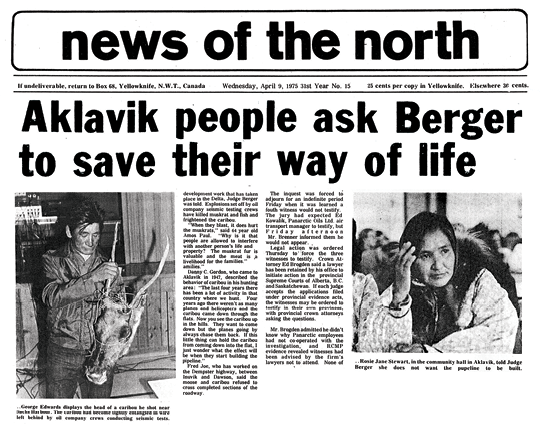
Good question: How did I, born and raised in
Toronto, become a reporter at the Berger
Inquiry in Aklavik? Environmental issues were
always important to me. Near home I saw
factories, highways and suburbs sprawling
on some of the world's best farmland.
Journalism grew attractive. It promised to
put me in the middle of events. I began
working at student newspapers. It was
difficult at the start: I was shy and it took
a long time to summon the courage to
phone for an interview. But I persevered.
Q. How did you begin writing ?
I got a job at the Ottawa Citizen, first as
a copy boy, then, as a reporter. I loved
the process of building a story. It's like
assembling a puzzle - gathering facts
and quotes, figuring out how to arrange
them to tell a meaningful story and, then,
editing the words and grammar to make it
stronger.
The Citizen was an ideal place to start,
because it had space for long features.
They threw young reporters into difficult
assignments and had tough editors whose
critiques were better than journalism school.
Q. How did you prepare?
I'd been in the NWT for only three months
when we flew to the Delta for the first
community hearing, I had never been outside
of Yellowknife. It was April 2, still cold and
snowy: a world completely new to me.
I wandered around the hamlet, shooting
photos of the community. I talked briefly
with a few people who spoke English -
briefly, because both they and I were shy.
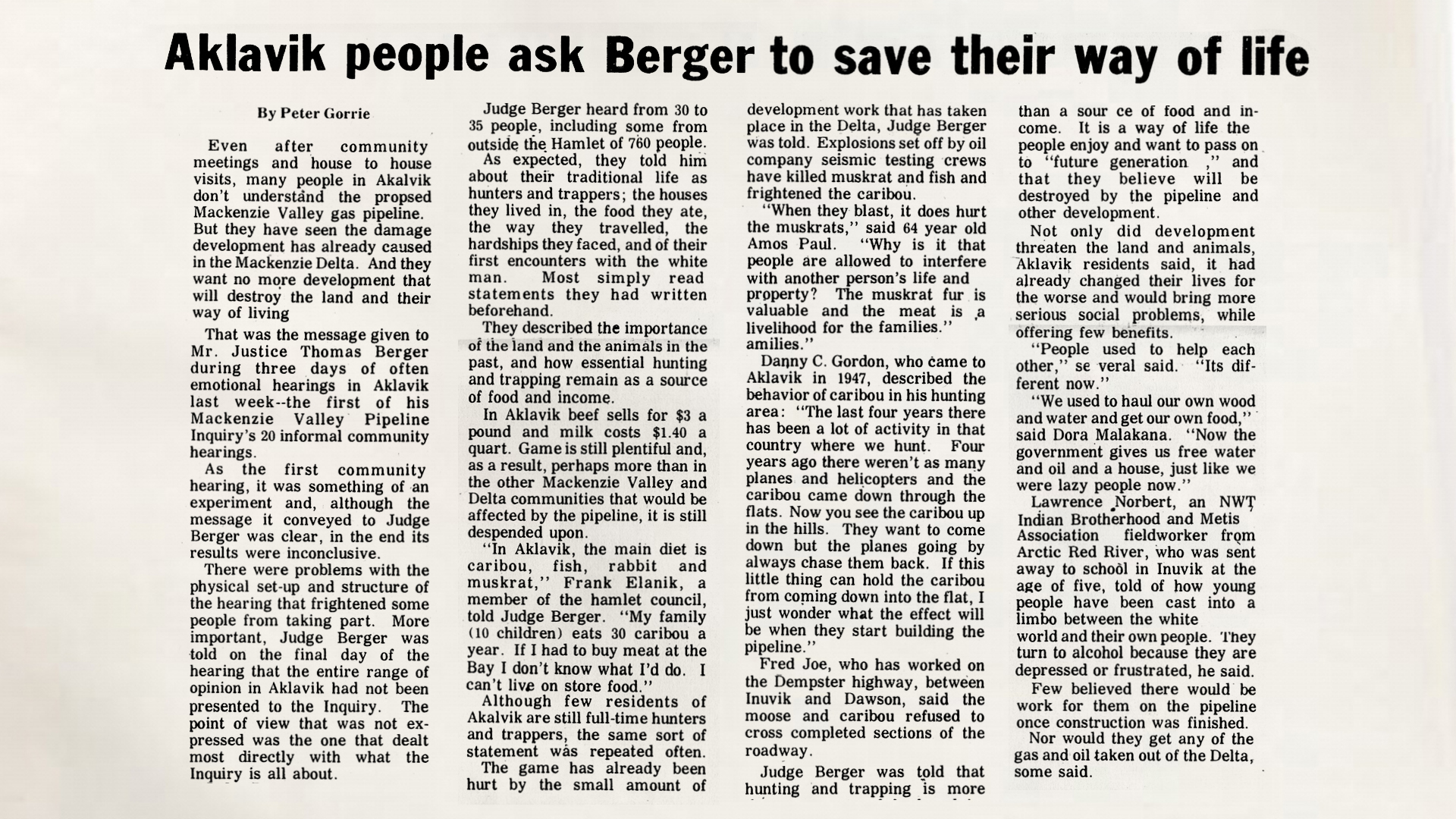
I went to a dance. By the time the hearing
began, I had learned something of Aklavik's
community life. I was ready.
Q. How did the Aklavik hearing change you?
Through it all I came to a conclusion that
has coloured my views ever since: Aklavik
was home to nearly 800 people, who had
every right to be there, and every right,
also, to object and resist when someone
else tried to transform or take that home
and way of life from them.
It was up to them to decide the speed of
change. Without that, they were facing
more of the colonialism that has persisted
throughout human history. Here was,
perhaps, one last place to keep it at bay.
Q. Did your views affect your story?
At the News of the North, the publisher
Colin Alexander and I had different opinions
about the Berger Inquiry. He wanted the
pipeline built. But I had grown up with the
1960s desire for change. I was supportive
of the Inquiry. I believed anyone who would
be impacted by the project should be heard.
Despite our differences, Colin published the
stories I wrote without changing them. In
return, I tried to present all sides, although
I gave more space to pipeline critics as well
as Dene and Inuit speakers.
For me, the best way to write a story was
to start from memory, without looking at
my notes or listening to voice recordings. I
simply wrote down what came to my mind
first, because that was likely the most
important element for the story.
I wrote as much as I could from memory,
pretending I was telling the story to friends
or family. When I came to a place where I
wanted to use a quote or needed to check
a fact I'd mark the spot. Later, I'd find
what I needed in the notes or recordings.
On my first assignment, I was to go to the
Giant Yellowknife mine to take photos of a
nurse clipping hair from miners, to test for
arsenic poisoning. This was in the days of
film cameras. I took photos from all angles.
Very pleased with myself, I raced back
to the office to brag. The sinking feeling
began when I started to rewind the film.
There was none of the usual tug as I
turned the wonder on top of the camera.
The feeling got worse when I kept winding
and realized there was no film in the
camera.